Last week, I wrote about belief in God. Sticking with taboo subjects, I turn this week to politics. Both areas provide an opportunity to listen.
—————————————
Politics
More than a century ago, humorist Mark Twain reminded us there are three types of liars; “liars, damned liars, and politicians.”
Some things never change!
Political views in The United States are about as divided as they’ve been since the Civil War. We’ve lost sight of the big picture.
I believe in democracy. That’s shorthand for trusting that over time, voters will lead the country in the right direction. That doesn’t mean politicians will be honest, or that voters will be informed. Despite inherent shortcomings, democracy has produced outstanding results. We seem to have forgotten that.
Politically, we are entrenched in a blood match. Both sides believe the future of the nation hinges on their side prevailing. Neither side will give an inch to pursue common goals or a greater good. A frightening number of people no longer trust our voting system. The rule of law is coming under question.
Young people are becoming disenfranchised with democracy. These are dangerous times.
The problem, however, isn’t the system; it’s us.
Increasing numbers of people believe democracy no longer works. However, when the populace is staunchly divided, democracy produces a stalemate by design. In a democracy, the ship of State tacks left and right. This means roughly half the time, half the people think we’re going in the wrong direction. They’re usually right, and eventually, the ship corrects course. We’ve been doing this successfully for nearly 250 years, the exception being the Civil War. That war was fought over the issue of slavery. Can anyone tell me what single overriding issue of such importance divides us today?
When things at home get upside down, my buddy Peter quips, “For this, I blame myself.” This admonishment applies to our country.
My generation, aka Boomers, ushered in a new generational ethic that stuck. We’re referred to as the “Me” generation. The generation following us caught that wave. Today, identity politics rules! What happened to we the people?
During the last decade, we’ve gone tribal. It’s not just that we hold differing views; that’s always been the case. The difference now is that we shun each other. Today, most young people say they wouldn’t date or marry someone from the other side. That’s disturbing!
When extreme personal viewpoints stymie beneficial collective action, the country is headed for a fall.
We are there!
Interestingly, such circumstances have occurred many times before. Neil Howe outlines this in his recently published book, The Fourth Turning Is Here. It’s the most interesting book I’ve read in quite a while. Unfortunately, it’s terrifying.
Howe first proposed his theories on generational cycles in a 1997 book, co-authored with William Strauss, titled The Fourth Turning: An American Prophecy – What the Cycles of History Tell Us About America’s Next Rendezvous with Destiny. I read the book in 1998. The book anticipated a triggering collapse within the new millennium’s first decade (the 2009 financial crash and continuing recession fit the description), signaling the beginning of the Fourth Turning.
Howe’s premise is that societies follow generational cycles. He makes a compelling case using the historical record. Quoting Howe’s recent book: “The generational cycle plays out in four turnings. The first turning is a high, an upbeat era of strengthening institutions and weakening individualism. The second turning is an awakening, a passionate era of spiritual upheaval when civic order comes under attack. The third turning is an unraveling, a downcast era strengthening individualism and weakening institutions. The fourth turning is a crisis, a decisive era of secular upheaval propelling the replacement of the old civic order.”
I spent much of my career trying to correctly forecast agricultural commodity prices. Cycle work played a significant role in our approach. My experience studying cycles is that while repetitive, they often lack sufficient regularity to be predictive. Howe acknowledges this point in his book. Nevertheless, cycles persist for a reason. Summer follows spring, autumn follows summer, and winter follows autumn.
Howe believes we entered the winter of our generational cycle around 2009.
When a nation becomes hopelessly divided, losing trust in its foundational institutions, often, the only thing capable of reuniting the populace is broad-scale catastrophe. This situation has repeated throughout US history. The American Revolution, The Civil War, and The Great Depression/World War II all came at the end of the 80-100-year generational cycle, aka The Fourth Turning. The pattern is evident going back 400 years in English History. A fourth turning crisis occurs when events trigger an upheaval. Howe expects our current cycle to climax sometime in the mid-2030s.
Maybe Howe is wrong (let’s hope so), but perhaps he is not. Increasing numbers of people feel like The United States is headed towards civil war. How likely do you think it is that we’ll set aside our differences to pursue common goals? Not likely, right? Maybe that’s why generational cycles persist!
Democracy bestows privileges and responsibilities. We, the people, have a responsibility to form a more perfect union. Neither party has demonstrated a willingness to collaborate towards a greater public good, like fixing our broken medical system.
We should lay our weapons down, acknowledge our differences, and begin working toward mutually beneficial goals. This is not a popular perspective. Friends tell me they feel compelled to stand firm in opposition. The problem is that this historically leads to disaster.
In Spiritual matters, I default to the foundational truth of love. In politics, I default to a foundational belief in We! These foundational principles are more important than our individual differences.
Is there anything we can do?
We need to practice accepting one another. It’s okay to disagree; even firmly disagree, that doesn’t preclude working together. We need to apply the energy of our animosity to works that drive mutually beneficial progress. I’ve been told that’s hopelessly naive, which is probably true.
Art inspires when logic fails. Song lyrics bring me to a close:
You may say I’m a dreamer
But I’m not the only one
I hope someday you’ll join us
And the world will live as one
-Imagine, John Lennon
—————————————————————
If you enjoy my posts, please share them with a friend. Previous posts can be found here by subject category, and here chronologically. You can subscribe to my latest posts by filling in your email address at the bottom of this page.
Towards A Life Well-Lived, is now a book.
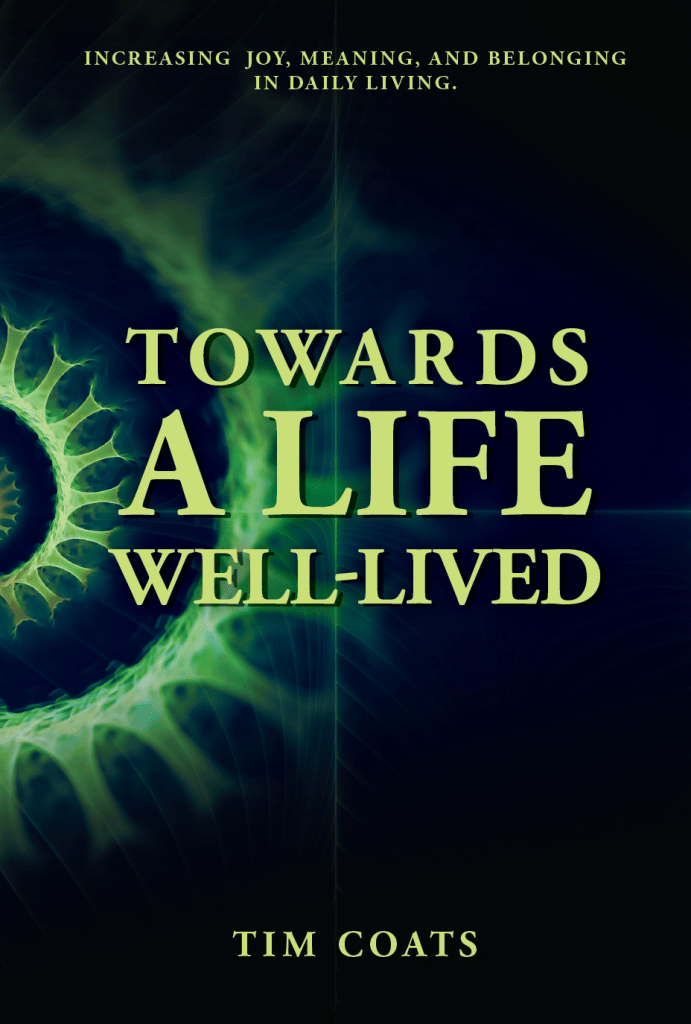
To purchase a copy, please click this link
Proceeds donated to support individuals suffering with anxiety and/or depression.
 Towards A Life Well-Lived
Thanks Tim—great thoughts and comments as usual—you have been coaching us over the past year about the importance of ” WE”…… And now as you point out it is more important than ever in our Democracy—-” We The People” ……Let’s help make that happen—-God Bless !!
Wren.
LikeLike