
Among my fond childhood memories are successful attempts at making my siblings laugh at inappropriate moments.
Church services provided a perfect opportunity. We never missed church on Sunday, and when the minister began his sermon, a hush fell over the congregation. If I could make a funny face and catch my brother’s eye at the right moment, I could entice an involuntary nasal response that would resound through the pews. The only drawback was such outbursts got me in as much trouble as him. Mom and Dad failed to see the humor in this game. After the service, we would get the standard lecture:
“I’m ashamed of you, now act your age!”
This is reasonable advice, provided parents and children have a common age in mind. We were perfectly fine acting our chronological ages of twelve and nine; our parents were thinking of a different one.
I’ve found that such temporal misalignments don’t improve with maturity.
After a certain age, elders start believing their medical problems are fascinating to others. They love to discuss knee and hip replacements, heart bypass surgeries, and other medical procedures. Who can fault them? They are acting their age. Such conversations always produce a boomerang response:
“Your hip replacement sounds awful, but let me tell you about my bypass surgery.”
Geriatric medicine often dominates conversations for medicare recipients, boring everyone present except the storyteller.
This is not a rebuke of elders. Thirty, forty, and even fifty-somethings are no better. Their favorite stories revolve around crappy jobs and inconsiderate bosses. My buddy complained relentlessly about his job whenever we got together. Once he retired, he dropped work stories for the fascinating details of his latest medical drama. I am not throwing him under the bus; he is simply acting his age!
Based on empirical evidence collected over a lifetime, I’ve concluded that no one wants you to act your age. Instead, we prefer people’s behaviors to be consistent with an unspecified aspirational age.
What age should we aspire to?
That’s not an easy question to answer. Fortunately, Peter Attia, in his book Outlive, The Science and Art of Longevity, provides helpful guidance for those of us with a lot of experience circling the sun:
“I think people get old when they stop thinking about the future. If you want to find someoneʼs true age, listen to them. If they talk aboutthe past and they talk about all the things that happened that they did, theyʼve gotten old. If they think about their dreams, their aspirations, what theyʼre still looking forward to – theyʼre young.”
I aspire to be young in spirit, which means I’ll have to drop beloved stories of medical trauma.
Life isn’t fair!
If youngsters aspire to maturity beyond their years, they must relinquish stories that make milk come out of their buddy’s noses. If middle-agers want to remain young at heart, they must give up stories about soul-crushing jobs. I’ve already covered the challenge for elders.
Just remember this:
No one wants you to act your age!
—————————————————————
Installments of The Secret Within can be found here.
Former blog posts can be found here by subject category and here chronologically.
You can subscribe to my latest posts by filling in your email address at the bottom of this page.
My first book, Towards A Life Well-Lived, can be purchased by clicking this link. Proceeds from sales are donated to Peace In Schools, a Portland, Oregon-based organization that supports mindfulness training in high schools.
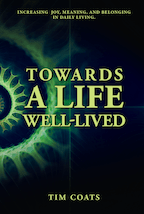
 Towards A Life Well-Lived
Tim—As you can imagine— I have never acted my age !!! And still do not intend to—– there is still too much future to look forward to !!!
The Wren.
LikeLike
Thank goodness! Some day will have to catch up on the latest in Carrizozo.
Tim
>
LikeLike