
In the late 70s, a regular feature of TV’s Saturday Night Live’s Weekend Update segment was a skit called Point-Counterpoint, starring actors Jane Curtin and Dan Akroyd.
The skit featured a political opinion expressed by Jane Curtin and a caustic response from Dan Akroyd. In the most famous of these skits, Curtain argued that a woman should be financially compensated in a breakup settlement for her contributions to a domestic partnership. Dan Akroyd’s response will forever be remembered in the annals of comedic political satire:
“Jane, you ignorant slut!”
Crude? Yes!
Shockingly funny for 1978? You bet!
America’s extreme political polarization is now cliché. We have become Saturday Night Live’s Point-Counterpoint! We live in a post-truth world where tribal views eclipse moral principle, leadership decorum, and judicial impartiality.
I don’t find opposing viewpoints disturbing. What disturbs me is the growing wholesale intolerance for listening to one another. Political leaders on both sides of the aisle weighed in on the tragic deaths of two Minneapolis ICE protestors prior to gathering facts. Multiple videos, shot from different angles, didn’t resolve anything.
What are we really talking about when seeing is no longer believing?
Welcome to Neil Howe’s The Fourth Turning. Howe believes history follows a cyclical pattern consisting of four turnings. Each turning lasts a generation, or roughly 20-25 years.
-The First Turning follows a crisis and features stability and renewed social cohesiveness.
-The Second Turning is an awakening, where society’s tenor switches to defiance.
-The Third Turning features an unraveling; people distance themselves from one another and become self-absorbed.
-The Fourth Turning is a period of crisis, threatening the very foundations of society.
We are in the Fourth Turning.
I write this as lead in to a fascinating article by Kevin Brown that appeared in the online weekly newsletter Dispatch Faith. The point of the article was that “ Beneath our disputes lie animating commitments, values, and a mental map of the world…the thing we’re talking about (is) not really the thing we’re talking about.”
Brown used a thought experiment offered by Nobel Laureate Amartya Sen to illustrate his point:
“Imagine three children fighting over a flute,” he says. “Anne wants it because she is the only one who can play it. Bob wants it because he is poor and has no toys. Carla wants it because she made the flute herself.”
The right way to award the flute depends on one’s worldview.
“Anne would find favor with the utilitarian, Bob with the egalitarian, and Carla the libertarian. All three appeal to impartiality, but the very impartiality they appeal to is partial to a specific moral tradition. Awarding the flute will not come from criteria of equality or impartiality, but rather the moral tradition the giver aligns with.”
That’s an important point to consider in the face of irreconcilable differences animating today’s political polarization.
I have difficulty understanding how people I respect can hold such starkly different political views from mine. Brown, rightly, suggests that one must look beyond specific issues to underlying value systems.
Attempts to find middle ground in the face of divergent value systems are probably a fool’s errand.
What does this imply?
Brown suggests the following:
“Moving from inflammatory discord to functional discourse will require more than empty platitudes suggesting we respect opposing views. It will require disciplined practice of seeing our neighbor as someone governed by a story that differs from our own.”
Reading Brown’s article reminded me of a book I read twenty years ago: Spiral Dynamics: Mastering Values, Leadership and Change by Don Edward Beck and Christopher C. Cowan. The book’s thesis mirrored Brown’s. The world doesn’t come to us as it is, but instead, as we are.
I experienced this in my own family. My father and I were not on the same page with respect to religion. Dad would attempt to “prove” points that I considered irrelevant. Spiral Dynamics helped me understand that our differences were anchored in divergent worldviews.
Democrats and Republicans are unlikely to compromise when compromises conflict with opposing value systems. Our sad state of affairs is unlikely to change without a paradigm shift in leadership or a significant increase in hardship that supersedes entrenched worldviews.
Until then, rather than degenerating into civil war, why not acknowledge the divergence in values and shift priorities to areas of shared concern? (I know, good luck with that!) The flute story illuminates that challenge. The utilitarian, equalitarian, and libertarian viewpoints are all logically justifiable, but sadly, socially irreconcilable.
Such is the nature of our times.
——————————————————————
Former blog posts can be found here by subject category and here chronologically.
You can subscribe to my latest posts by filling out your email address at the bottom of this page.
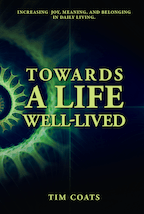
My first book, Towards A Life Well-Lived, can be purchased by clicking this link. Proceeds from sales are donated to Peace In Schools, a Portland, Oregon-based organization that supports mindfulness training in high schools.
Stay tuned for my new book, The Secret Within, which I expect to be available in March.
 Towards A Life Well-Lived
A good (and timely) one, Tim!
tv
LikeLike